


Almost everyone has a lawn, at least in the state of Nebraska, in the U S of A. And for many, our lawns are a point of pride. We compare the lush green expanse in front of our homes to that of our neighbors.
How thick is it? How green is it? Are there any bare spots? And if the grass is greener on the other side, why?
One possible answer? Fertilizer. Are you fertilizing your lawn?
That One Answer…
Well, there are many answers to what might be holding your lawn back from reaching the heights (figuratively, of course – heaven forbid we leave our grass too high) you’ve imagined. But one of the many factors that can hold you back if you’re not taking advantage of it is fertilization for your lawn.
Why Does Your Lawn Need It?
Have you ever heard of crop rotation? It’s a practice that farmers (and home gardeners) use to keep their soil balanced. Crop rotation is the process of changing plants grown each year in particular areas so that what one plant takes away from the earth, the next plant returns.
Think of it like this. Bobby (3), Timmy (5), and Ruth (16) are three siblings. Ruth has a part-time job, and one of her chores is to provide snacks for her little brothers. If every week she brings home five pretzels and five apples, the boys could theoretically get a snack every day.
But if Bobby and Timmy only eat pretzels, they will run out by Wednesday.
Different plants need different nutrients. So when the same plants are used yearly in the same spot, all of that specific nutrient will be eaten up.
And our lawns are there year after year.
When Should You Fertilize?
There are arguments to be made to fertilize many different times of the year. It partly depends on what kind of grass you have. Wheaton performs fertilization through several months of the year, from March through October, only taking off the coldest months when all of your grass lies dormant.
But that doesn’t mean you need to fertilize eight months of the year. It also doesn’t mean that any month within that time frame will do for your particular lawn. Ask the pros at Wheaton what time is best for your property.
How Do You Know You Need Fertilizer?
As a result of the Bobby & Timmy analogy, you can pretty much assume that your plants need fertilizer if you have a lawn every year.
But if you’re looking for more evidence, look at your lawn. If it is not entirely green and has spots less healthy than others, you need to fertilize it.
Fertilization Conditions
Pre-fertilizing, it’s a good idea to prepare your lawn, so it is optimally conditioned to take in the nutrient. It’s best to fertilize while the temperature is on the cool side. It’s also helpful to fertilize when the grass is moist.
Fertilizing in Fall
Knowing what you now know about the optimal fertilization temperature, it should be no surprise that we’re fertilizing right now and into the fall. But that’s not the only reason to fertilize in the fall.
If you have added any seeds to your lawn, which some homeowners do each autumn, fertilizing will help those seeds sprout and become healthy grass.
Benefits of Fertilizer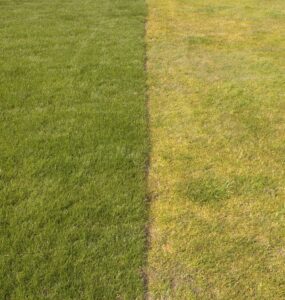
So you already know that fertilizer helps your grass to grow and become healthy. But did you know that it can also help to prevent weeds?
Your lawn is protected from weeds in two ways when you fertilize:
- When Your Grass is healthier, weeds have a difficult time growing. How can weeds be healthy if there’s nowhere to take root, and they’re crowded out by grass?
- The nitrogen that is so helpful to grass’s nutrition is also unhealthy for many weeds. Crabgrass, for example, the bane of many a lawn, can not tolerate the nitrogen levels in fertilizer.
Is it Ever Bad to Fertilize?
Like everything, too much of a good thing can cease to be good. If you use too much fertilizer, you risk harming or even killing your grass. Often the first sign of overfertilization is yellow lines on your lawn.
We don’t recommend trying to fertilize your lawn yourself. It’s best to talk to a pro. Not only do we know how to tell what fertilizer you need and how much, but we also have access to better fertilizers than you can purchase on your own.
So, is your lawn hungry? Let Wheaton get it fed!